


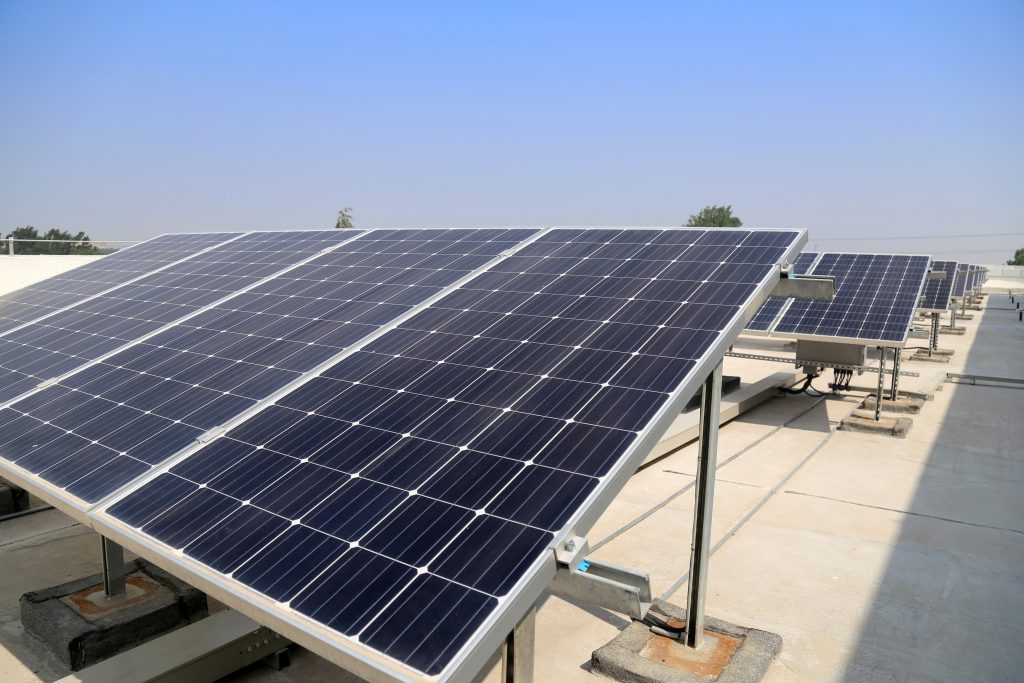
The solar industry has evolved far beyond the basic blue polycrystalline panels of the past. Today’s market is dominated by high-efficiency modules that generate more power in less space. When vetting a manufacturer, ensure they are utilizing these three cutting-edge technologies:
1. N-Type TOPCon Technology
Tunnel Oxide Passivated Contact (TOPCon) has become the gold standard in 2026. Unlike older P-type cells, N-type cells are immune to Light-Induced Degradation (LID). This means your panels won’t lose significant potency in their first few months of sun exposure.
- Efficiency: Often exceeding 22.5%.
- Longevity: Better performance in high-heat environments.
2. Bifacial Modules
Why catch sunlight from one side when you can use both? Bifacial panels have a transparent backsheet or double-glass construction, allowing them to capture reflected light from the roof or ground.
- Bonus Yield: Can increase total energy generation by 10% to 30% depending on the surface reflectivity (albedo).
3. All-Black and Shingled Cells
For residential users, aesthetics now match performance. Shingled cells eliminate visible busbars (the silver lines on panels), creating a sleek, seamless look while reducing “dead zones” on the panel surface.
5 Hallmarks of a Premium Solar Manufacturer
With hundreds of companies entering the green energy space, how do you separate the innovators from the assemblers? Look for these specific credentials:
1. Vertical Integration
The best manufacturers don’t just “screw parts together.” They are vertically integrated, meaning they control the process from silicon ingots and wafers to the final solar cell and module assembly. This ensures rigorous quality control at every micron of the production line.
2. Tier 1 Bankability
A “Tier 1” rating (often designated by BloombergNEF) isn’t just a badge of quality—it’s a badge of financial stability. It signifies that the manufacturer is “bankable,” meaning large-scale lenders trust their 25-year warranty. You want a company that will still be around in two decades to honor their promises.
3. Rigorous Testing Beyond BIS
While Bureau of Indian Standards (BIS) certification is mandatory, elite manufacturers go further. Look for:
- IEC 61215: For terrestrial PV modules.
- IEC 61730: For safety qualifications.
- Salt Mist Corrosion Testing: Essential if you live in a coastal or humid region.
4. Low Temperature Coefficient
Solar panels actually lose efficiency as they get hotter. A high-quality manufacturer produces panels with a low temperature coefficient (ideally around $-0.30\%/^\circ\text{C}$ to $-0.35\%/^\circ\text{C}$). This ensures that during scorching summer months, your energy production doesn’t take a nose-dive.
5. Advanced Warranty Terms
In 2026, a standard warranty is no longer enough. Look for:
- Product Warranty: 12 to 15 years (covers defects).
- Performance Warranty: 25 to 30 years (guarantees the panels will still produce $\approx 85-90\%$ of their original power).
Why Switching Now Makes Financial Sense
The economics of solar have reached a “tipping point.” With the implementation of smart grids and net metering, your solar system isn’t just a utility—it’s a revenue-generating asset.
| Feature | Impact on ROI |
| Net Metering | Sell excess power back to the grid during the day. |
| Energy Storage | Pair panels with Lithium-ion batteries for 24/7 power. |
| Property Value | Solar-equipped homes often see a 4-6% increase in valuation. |
Pro Tip: In 2026, many manufacturers are offering “Smart Modules” with integrated microinverters. These allow you to monitor the performance of every single panel on your phone, making it easy to spot if a specific panel is shaded or needs cleaning.
Maintenance: The Key to 30-Year Performance
Even the best panels manufactured today require basic care. To maximize your output:
- Bi-Weekly Cleaning: Dust and bird droppings can create “hot spots” that permanently damage cells.
- Professional Inspection: Have a technician check the DC wiring and earthing once a year.
- Monitor the Inverter: The inverter is the “brain” of the system and usually has a shorter lifespan than the panels (approx. 10–12 years).
Conclusion
The transition to solar is the single most effective way to lower your carbon footprint while shielding yourself from rising grid electricity costs. By choosing a manufacturer that prioritizes N-type TOPCon technology, vertical integration, and Tier 1 reliability, you aren’t just buying hardware—you are securing your energy independence for the next quarter-century.