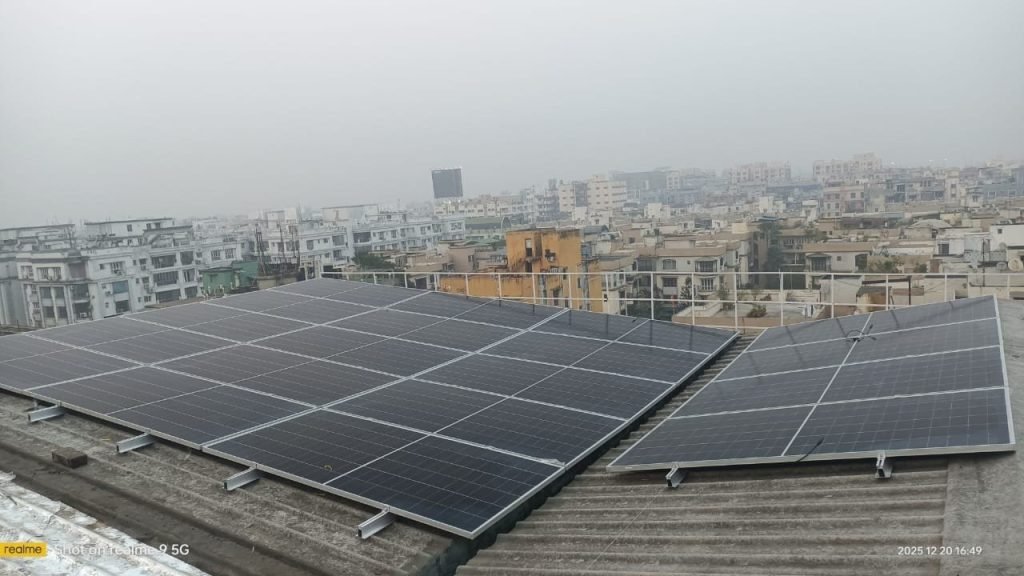

Walk around any industrial area in Kolkata or Howrah these days and you’ll notice something new on a lot of rooftops: solar panels. It’s not just about looking green. For most factory owners, office managers, and warehouse operators, the decision is straightforward — electricity bills have become too painful to ignore.
Commercial and industrial power rates in the city often sit between ₹7 and ₹10+ per unit. At the same time, Kolkata gets roughly 5.1 peak sun hours a day and generates about 1,400–1,700 kWh per kWp every year. When you put those two numbers together, rooftop solar starts making real financial sense.
Why Kolkata businesses are actually making the switch
A few practical reasons keep coming up in conversations with plant managers and CFOs:
- Daytime operations line up almost perfectly with peak solar generation. Offices, factories, cold storages, and hospitals use most of their power when the sun is out.
- The 40% accelerated depreciation under Section 32 of the Income Tax Act gives a solid tax shield in the first year — often recovering 10–12% of the project cost.
- Net metering, net billing, and gross metering rules from WBERC (with both CESC and WBSEDCL) make it possible to export excess power.
- Tariff hikes keep coming. Solar locks in a large part of your daytime energy cost for the next 20–25 years.
- Customers and investors are asking for ESG numbers. Solar cuts Scope 2 emissions and looks good in sustainability reports and tenders.
A well-planned Commercial solar system simply reduces the monthly electricity bill while making costs more predictable.
How much can you actually save?
Most well-planned rooftop systems cut electricity bills by 50–90%, depending on how much of the power you use on-site. Typical numbers we see:
- Payback in 3–6 years (often 3–5 years once you factor in the tax benefit).
- Near-zero daytime electricity cost for the remaining 20+ years of the system’s life.
- Lifetime savings that easily run into lakhs, and for larger plants, into crores.
Businesses with heavy daytime loads — engineering units, leather factories, cold storages, hospitals, educational institutions — usually see the fastest returns.
The tax angle that many people miss
Commercial and industrial solar does not get the residential PM Surya Ghar subsidy. What it does get is accelerated depreciation: 40% in the first year. That tax shield is often worth more than many people realise. GST input credit also helps bring down the effective capital cost. Just make sure the system is commissioned with more than 180 days left in the financial year if you want the full first-year benefit.
Reliability and day-to-day operations
Solar doesn’t just save money — it reduces dependence on the grid during the hours when production is highest. Many facilities are now adding a Hybrid solar system with battery backup so that short grid fluctuations don’t interrupt operations. This is especially useful for continuous-process industries.
ESG and brand value
Cutting Scope 2 emissions is no longer just a nice-to-have. It strengthens ESG reporting, helps in tenders, and improves how customers and investors see the company. For MSME clusters around Kolkata and Howrah, the combination of lower operating costs and lower emissions is hard to ignore.
What to check before you install
A few practical points that make a big difference:
- Size the system to your daytime load, not just the available roof space. Maximum self-consumption gives the best returns.
- Choose high-efficiency modules that handle Kolkata’s heat and monsoon conditions well.
- Work with a local EPC that already knows the CESC and WBSEDCL processes. Approvals and net-metering paperwork can otherwise drag on.
- Factor in basic maintenance — mainly cleaning and routine checks. Most good installers offer multi-year O&M support.
- Look at financing options. CAPEX usually gives the highest long-term returns, but OPEX/RESCO and loan models exist if you prefer lower upfront cost.
- Get a proper roof assessment for structural strength, orientation, and shading.
Choosing the right Rooftop solar panels is essential for consistent generation and long-term performance in Kolkata’s weather conditions.
Why a local EPC matters
Accurate load analysis, the right components, clean engineering, and smooth DISCOM coordination decide whether a project runs smoothly or becomes a headache. C-Fritts Power Pvt. Ltd., based in Haltu Neli Nagar, Kolkata, handles end-to-end commercial and industrial solar projects across West Bengal. They work with Tier-1 equipment, manage CESC and WBSEDCL net-metering, and design systems for local conditions. Factories and large manufacturing units often require a custom Industrial solar system that can handle higher loads and deliver stronger returns on investment.
Frequently Asked Questions
Is solar worth it for commercial buildings in Kolkata?
Yes for most businesses with decent daytime loads. High tariffs, good solar irradiance, tax benefits, and 3–5 year payback periods make it one of the clearer ROI decisions available right now.
How long does a commercial solar system last?
Quality systems typically perform for 25 years or more, and panels come with long-term performance warranties.
Can businesses export excess solar power?
Yes. Under WBERC rules you can export through net metering, net billing, or gross metering with CESC or WBSEDCL, subject to system size and category.
What size system do most Kolkata businesses need?
It depends on monthly consumption and roof space. Offices often need tens of kWp; industrial plants can go into hundreds of kWp or even MW scale.
How quickly can a commercial solar project be completed?
Timelines vary with system size and approvals. An experienced local EPC can keep the process moving from survey through to commissioning without unnecessary delays.